73: Efficient Feed Dog Usage
No Comments
Effective understanding and use of feed dog speeds the sewing and enables professional results
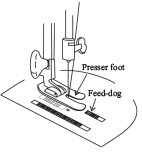
The presser foot and feed dog work together to feed fabric through the machine as the seams are sewn.
However, the two work slightly differently, making several procedures, such as sewing to match and easing in fullness easier to do.
The feed dog moves up, then back as it pulls the fabric through the machine.
The presser foot lifts slightly, then lowers, allowing the feed dog to pull the fabric back as the fabric is sewn together.
Because the presser foot does NOT move back, if one does not have full control of the sewing the top ply of fabric will move slower through the machine than the bottom ply of fabric.
Sewing notch-to-notch solves this problem.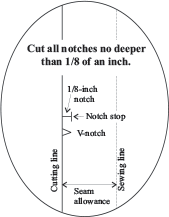
Snip the center of notches
printed on home sewing patterns so as to be able to align the two plies of a seam as the plies are sewn together.
There are times when allowing the bottom ply to sew faster than the top ply speeds sewing
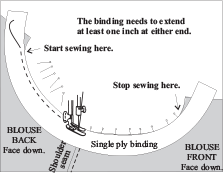
as the sleeve cap is sewn into the armhole.
Easing Fullness
Allowing the feed dog to ease in a sleeve cap’s fullness speeds sewing. Pin the notches, then pin in the ease. Sew the cap into the armhole before the side seams are sewn. Then sew the side seams. Finally sew the armhole closed where it is still open at the underarm.
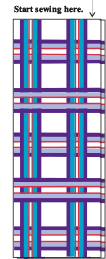
Sewing to Match
Holding the bottom ply slightly behind the top ply, enables perfect matching.
In the diagram on the left the bottom ply is shown slightly extended to the right to illustrate how the bottom ply is laid slightly behind the top ply before the seam is sewn.When sewing to match lay the plies edge-to-edge with the bottom ply laid slightly behind the top ply.
Used in the industry, first test with sample fabric, just how much to hold the bottom ply as the fabric moves through the machine.
Three important considerations:
1. The garment must be cut to match.
2. The two plies of fabric must be cut on the same angle to the grain line.
3. The fabric cannot be basted or pinned.
The amount of the bottom ply that is held back varies with different fabrics, but is usually no more than 1/16 of an inch, making the fabric look as if it is about to be miss-matched as it approaches the needle.
As the fabric moves under the needle, the feed dog will pull the bottom ply in, causing the fabric to match perfectly.
Laurel wrote an article about seam allowance modification for Threads Magazine in their 199 issue, August (2018).
Your comments are most welcome – Laurel
LaurelHoffmann-YouTube
https://laurelhoffmann.com/
https://www.facebook.com/CFashionEdu
https://www.linkedin.com/in/laurelhoffmann/
https://www.instagram.com/laurelhoffmann4015/
RSS Feed: https://laurelhoffmann.com/blog/
https://www.ravelry.com/projects/LaurelHoffmann
https://www.yelp.com/biz/laurel-hoffmann-oreland
https://www.thumbtack.com/pa/philadelphia/drawing-lessons/fashion-drafting-sewing-books-classes
https://laurelhoffmann.com/
https://www.facebook.com/CFashionEdu
https://www.linkedin.com/in/laurelhoffmann/
https://www.instagram.com/laurelhoffmann4015/
RSS Feed: https://laurelhoffmann.com/blog/
https://www.ravelry.com/projects/LaurelHoffmann
https://www.yelp.com/biz/laurel-hoffmann-oreland
https://www.thumbtack.com/pa/philadelphia/drawing-lessons/fashion-drafting-sewing-books-classes
© Laurel Hoffmann, 2018.
Professional Drafting and Sewing Books
-
 Sewing Techniques from The Fashion Industry
$151.00
Sewing Techniques from The Fashion Industry
$151.00
-
The Basics for Drafting & Fitting Pants and Skirts
$135.00
-
The Basics for Sewing Pants and Skirts
$188.00
-
Copying a Man's Shirt
$153.00
-
Grading to Fit
$196.00
-
Grading & Sewing a Blouse to Fit
$152.00
-
Grading a Woman’s Jacket to Fit
$153.00
-
Tailoring a Woman’s Jacket
$128.00