20: High-End Industrial Couture Procedures
No Comments
Here are some of the high-end cutting procedures used in industrial couture
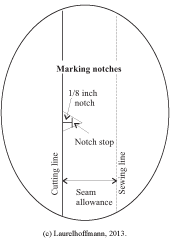
About notches
Because the industry sews the seams edge-to-edge, notch-to-notch, marking and cutting notches correctly is extremely important. Notches should be marked with just a straight line in the center of the triangle on home sewing patterns. Cut notches no deeper than 1/8 inch.
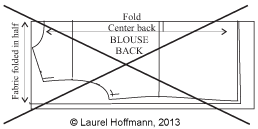
NEVER cut fabric on the fold for these reasons:
Unless the fold of the pattern is perfectly aligned with the fabric’s fold, the cut fabric piece will have lost or gained a triangular wedge down its center, distorting the entire piece. Cutting on the fold can increase the width of the fabric piece at the fold by 1/8 inch or more, depending on the thickness of the fabric.
If the underlying ply of fabric is off-grain the piece cut from it will be off-grain.
Most layouts on the open produce tighter layouts than they would on the fold. This saves fabric and money.
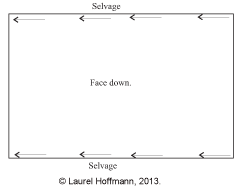
Patterns are laid one direction
To ensure that there will be no shading in the finished garment one side of the fabric is chosen to be the face. The direction the fabric will hang is also determined. To make sure all pieces will be cut the same direction arrows are sometimes chalk marked on the selvage on the wrong side of the fabric.

Difficult fabrics are often cut between two plies of tracing paper
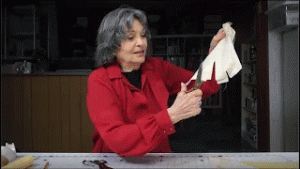
Students often ask, But won’t cutting through paper dull the sheers? Apparently the answer is no. Anyway, what did you buy them for? Shears can be sharpened. What matters is that you produce beautiful clothes. Cutting fabric and paper together never seems to dull my shears.
 In this photo embroidered silk has been laid over tracing paper. A scarf pattern that has not been cut has been laid over the embroidered silk. The patterns for a picture hat will be laid on the remaining fabric. When the hat patterns were added this proved to be a very tight layout. As long as the patterns do not overlap, a layout is not too tight.
Careful cutting yielded not only the scarf and hat, but also the hat’s trim.
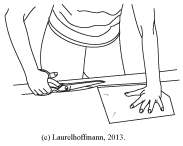
The garment pieces are cut from right-to-left if right-handed, left-to-right if left-handed
Block out (industrial jargon meaning to cut around the garment piece so it can be separated from the rest of the layout) one of the pieces, then turn the block as you cut so that you continually cut from right–to-left. Slide the shears on the table as you cut. This gives momentum and speeds the cutting.
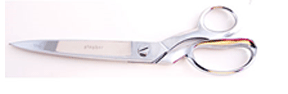
Design room personnel use 12-inch shears
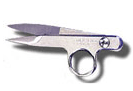 Consider also buying a pair of little snips, used throughout the industry to snip threads.
More later, Laurel
https://laurelhoffmann.com/
https://www.facebook.com/CFashionEdu
https://www.linkedin.com/in/laurelhoffmann/
RSS Feed: https://laurelhoffmann.com/blog/
https://www.ravelry.com/projects/LaurelHoffmann
https://www.thumbtack.com/pa/philadelphia/drawing-lessons/fashion-drafting-sewing-books-classes
Professional Drafting and Sewing Books
-
 Sewing Techniques from The Fashion Industry
$151.00
Sewing Techniques from The Fashion Industry
$151.00
-
The Basics for Drafting & Fitting Pants and Skirts
$135.00
-
The Basics for Sewing Pants and Skirts
$188.00
-
Copying a Man's Shirt
$153.00
-
Grading to Fit
$196.00
-
Grading & Sewing a Blouse to Fit
$152.00
-
Grading a Woman’s Jacket to Fit
$153.00
-
Tailoring a Woman’s Jacket
$128.00