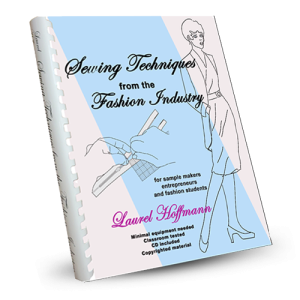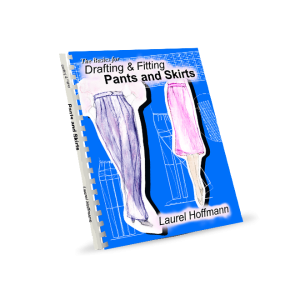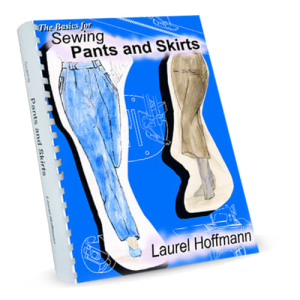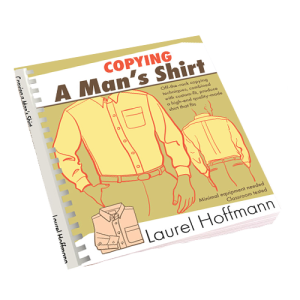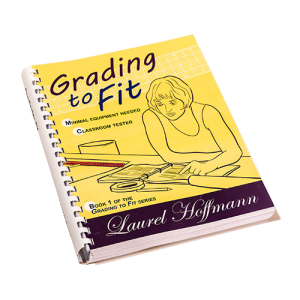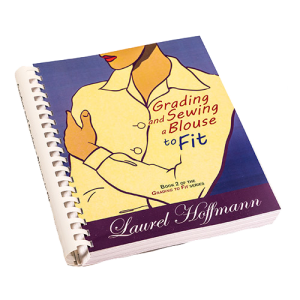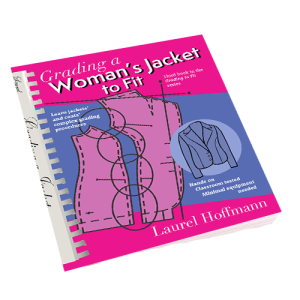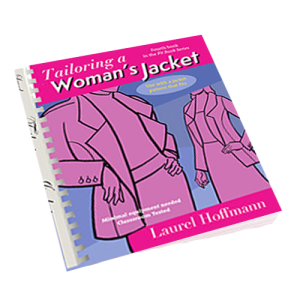
Thinking about starting a clothing line? If so, you need to learn the procedures presented in Laurel’s books.
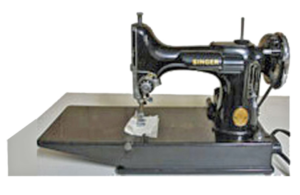
can be used with industrial sewing procedures.
In the industry manufacturing cheap clothing usually requires complex machinery. Most high-end clothing can be made on a basic, straight-stitch sewing machine.
You may already know that industry sews using different sewing methods than those used in home sewing procedures. Laurel’s books addresses those differences, differences you need to know if you are to successfully make and market your line of clothing.
Most sewing books on the market present home sewing methods that are slow, time consuming, and not very dependable. To produce salable clothing that can be manufactured in the industry, you need to know the methods used by the professionals.
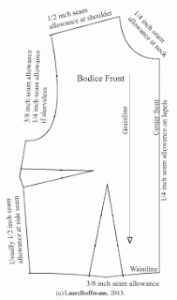
The industry drafts varying seam allowances on their patterns. Reducing seam allowances saves both fabric and time. Neat, clean seam allowances enable the production of professional garments.
Although it’s quite common for people who sew at home to think industrial drafting and sewing methods have nothing to do with them, nothing could be further from the truth. With almost no exceptions, designing departments procedures can be used in the home. Using equipment quite similar to that available to any home sewer, high-end designing departments produce exquisitely beautiful clothing for their preferred customers. So what’s the secret? The professionals know drafting and sewing procedures not currently known by most of the population. YOU can learn these skills AND you can use them in your home to produce exquisitely beautiful garments, like those produced in the industry, for yourself, your family, and your customers.
The most expensive item you need to start your fashion business just may be just a little feather-weight like the one shown above that I use to demonstrate sewing skills in my classes. They sell on e-bay for as low as $300!
Here is an overview of what is involved: 1. designing a line, 2. preparing the patterns for production, 3. producing a graded line of sizes, 4. preparing your line for mass-production, and 5. how to do this in your home with minimal expense. All of the information in Laurel’s books is from the industry. Her books present how the industry designs, drafts, cuts, and sews.
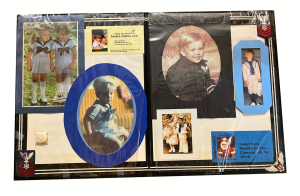
The books offered on my websit show you how to convert patterns you already have into patterns that can be used to produce your sample garments.
In the industry patterns are developed from patterns previously used to cut clothing that sold well in the market place. Learning how to convert patterns already owned and proven into patterns that can be used to cut and sew samples for your line of clothing will save you considerable time, effort, and expense.
Yardage, sample making, and pricing are all addressed as well. In the industry yardage is so important to a company’s bottom line, the yardage needed to cut a garment is determined long before the garment is approved for sale. Good layouts save waste and, as a result, hundreds of dollars in the industry.
Laurel ‘s short bio: I first worked in a couture shop on the Main Line in Philadelphia, then worked in designing departments, including industrial and couture bridal, then worked as a production pattern maker in factories in Philadelphia, drafting and grading patterns . For the last 25 years I taught these skills at Philadelphia University and Drexel University, where I developed my continuing professional education fashion technology program and its supporting books, scaling down and personalizing industrial fashion technology so it can be used effectively in home businesses. I now teach in my home-based studio, just northwest of Philadelphia.
Laurel
LaurelHoffmann-YouTube
https://laurelhoffmann.com/
https://www.facebook.com/CFashionEdu
https://www.linkedin.com/in/laurelhoffmann/
https://www.instagram.com/laurelhoffmann4015/
RSS Feed: https://laurelhoffmann.com/blog/
https://www.ravelry.com/projects/LaurelHoffmann
https://www.yelp.com/biz/laurel-hoffmann-oreland
https://www.thumbtack.com/pa/philadelphia/drawing-lessons/fashion-drafting-sewing-books-classes